 PET-SHEET.COM


Buying ESD PET Sheet for Electronics Trays? Check Resistance After Forming

The supplier’s flat-sheet report is within the range you asked for, and purchasing is ready to order the antistatic PET sheet roll. But the component will sit on support pads inside a drawn pocket, and the report describes a flat sample. Use that reading to shortlist the roll. Base material approval on measurements from the surfaces that matter on the formed tray.
Which tray surface has to meet the resistance requirement?
Start with how the tray handles the electronics. Mark where the component rests, where it can touch a wall during loading or removal, and whether the project also specifies any exterior handling surfaces. Ask the project’s ESD owner to confirm the resistance limits, what kind of resistance is specified, and which surfaces must meet those limits. For a surface resistance requirement, a through-thickness reading answers a different question.
For a coated sheet, we start by asking which face is treated and how the roll must be fed to put that face where the drawing calls for it. If the specification covers both faces, qualify both. Put the required face and the way it will be identified on the roll in the request for quotation (RFQ). That gives purchasing, the forming team and incoming inspection the same reference.
Can you compare the flat-sheet report with the tray requirement?
Check what the supplier actually measured before using the number to compare grades. Ask for the grade and lot, measured face, test method, electrode arrangement, and conditioning details. Include the temperature, relative humidity and conditioning time where the method calls for them. Agree on any specified test voltage and reading time as well. A report that gives only a value in ohms leaves too much room for two labs to make different measurements.
Keep a flat sample from the same trial roll as the formed trays. That gives you a baseline for the lot you actually formed. Agree on how the flat sample and tray will be conditioned and measured. If the tray geometry requires a different fixture or electrode arrangement, document that difference and agree with the ESD owner on how the tray result will be judged. A difference between readings can reflect the measurement setup as well as the effect of forming.
Where should you check resistance after forming?
Mark the test locations on the drawing before the trial. On a deep-pocket tray, a rim reading is easy to obtain, but it tells you little about a support ledge halfway down the wall. Drawn areas can stretch and thin unevenly, and the coating distribution can change with the draw. Include the locations the component actually touches and the deeper features where forming may have the greatest effect.
| Location to mark | What the check helps you decide |
|---|---|
| Component seats, support pads or contact ledges | Whether the working surface meets the project limit where the part rests or bears against the tray |
| Drawn sidewalls and transitions into corners | Whether more heavily stretched areas give different readings, especially where a part can touch during handling |
| Deepest accessible cavity or thin-wall feature | Whether the selected sheet holds up at a demanding location under the agreed measurement setup |
| Rim or flange | How a relatively lightly drawn area compares, or whether the rim meets its own requirement if the project specifies one |
Agree on the exact electrode positions and check that the fixture fits before committing to the test map. If a required contact area is too narrow for the planned electrodes, settle on a suitable method and acceptance rule with the ESD owner before the trial. Keep readings by location and tray, with cavity identification where applicable. A tray-wide average can hide a required location that falls outside its limit.
Which coated grade should go on the purchase specification?
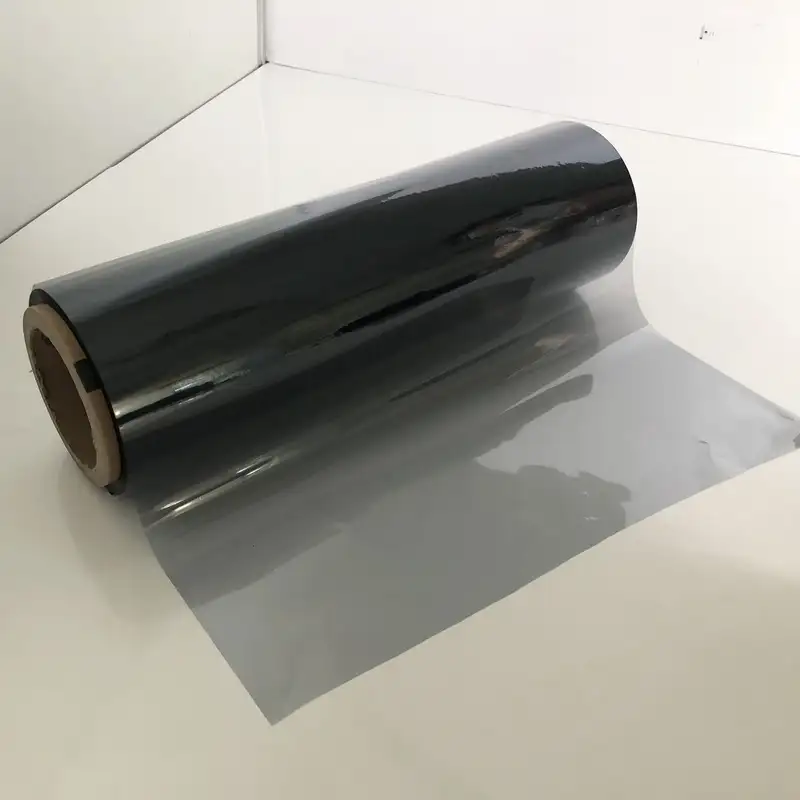
DESU offers online-coated antistatic and semi-conductive sheet options in PET or RPET. Depending on the grade and test conditions, the antistatic option has a resistance range of 10⁹–10¹¹ Ω and the semi-conductive option has a range of 10⁶–10⁹ Ω. Confirm availability for the selected structure, gauge, colour and roll format. Use the ranges to decide which grades to trial, then use the formed-tray results to decide which grade fits the project.
We would specify the antistatic grade if it consistently meets the project limits at every required location in a representative forming trial and satisfies any separate appearance or handling requirements. A lower flat-sheet reading alone gives little reason to move to the semi-conductive grade. If the rim passes but a required wall or contact ledge misses its limit, first confirm the treated-face orientation, electrode contact and conditioning. If the location still misses, compare another coated grade on the same tray geometry under the agreed conditions. Where clarity matters for inspecting the components, include a separate appearance check on those trial trays.
Once the grade is qualified, turn the trial into two sets of acceptance checks. For incoming rolls, specify the approved grade and construction, gauge and width with agreed tolerances, treated-face identification, lot traceability, and any flat-sheet resistance limits and documentation agreed with the supplier. Define where to sample the roll, how often to test and what happens if a result is out of limit. For formed trays, keep the location map, resistance limits, method and conditioning with the approval record. Set a separate schedule for tray checks and agree when a change in grade, coating or gauge calls for renewed qualification. This gives receiving a practical way to screen repeat orders while keeping the electrical requirement tied to the finished tray.
FAQ About Verifying ESD PET Sheet
Can we approve a different gauge of the same coated grade using the original tray results?
Use the original results as a comparison baseline and confirm the new gauge on the formed tray before approving it. A gauge change can alter how the sheet draws into the pocket. Repeat the agreed checks at the component-contact areas and the more heavily drawn features.
Is a resistance test enough if the specification also calls for static decay?
Run a separate static-decay test using the project’s specified method and acceptance limit. A resistance reading measures a different property and cannot establish the required decay time.
Do we need to retest trays that will be cleaned and reused?
Include a post-cleaning resistance check if the tray must meet its limit through repeated use. Agree on the cleaning procedure and the number of cycles to represent, then recheck the specified locations after the agreed conditioning.
Discuss Your ESD PET Sheet Requirements
Share your tray drawing, resistance requirement and test method with DESU, along with the intended sheet gauge, roll width and purchasing needs. We can discuss a suitable coated PET sample for your tray trial or prepare a quotation against the agreed sheet specification.
CONTACT PET-SHEET.COM
Our professional sales staff and technicians will determine the final characteristics of the product and material solution for the customer specific application and will provide the customer with a quote and a detailed time schedule, Please fill the form to contact our professional sales team.- Main Category
- APET Sheet Roll
- ESD Antistatic PET Sheet Roll
- GAG Sheet Roll
- PETG Sheet Roll
- RPET Sheet Roll
- Thermoforming PET Sheet Roll
- Latest Products