 PET-SHEET.COM


How Should Buyers Trial Anti-Fog PET Sheet for a Real Package?
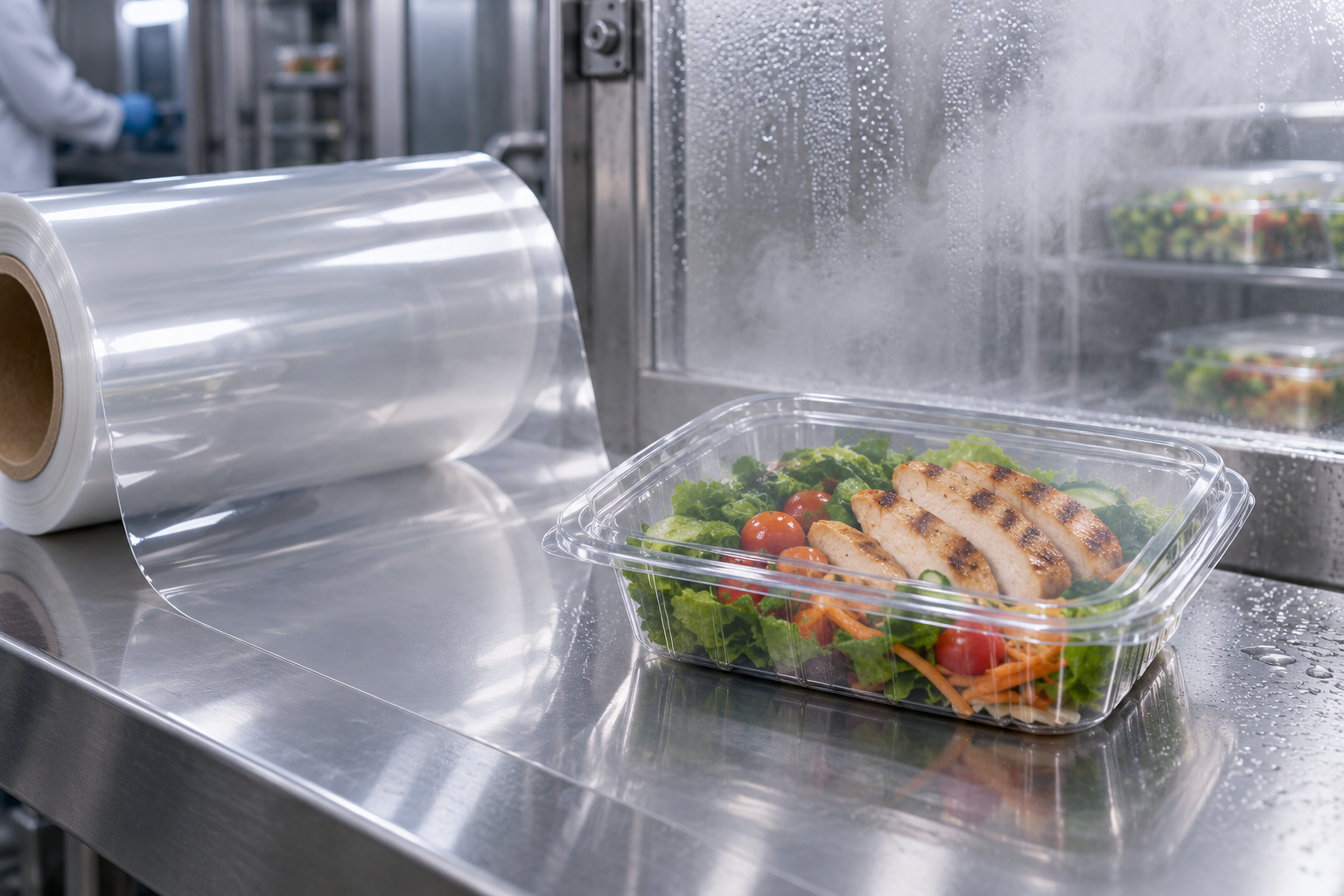
A clear anti-fog PET sheet sample can look convincing on a desk and still leave the project unanswered. The package may fog after warm filling, lose visibility during chilled storage, or form inconsistently around deep corners. A brief flat-sheet demonstration will not reveal all of those risks.
We usually start with a more practical question: under what conditions must the finished package remain clear? Once the product temperature, storage cycle, tray geometry and forming sequence are defined, a PET sheet sample for thermoforming trial can be evaluated against the actual job rather than a general anti-fog claim.
The objective is not to find the sheet that looks best before forming. It is to identify the option that provides acceptable visibility after forming, filling, closing, storage and handling without making production unstable.
Package Environment
Anti-fog performance has meaning only in a defined package environment. A chilled salad tray, a sushi pack filled near room temperature and a cup or lid exposed to a warmer product do not create the same condensation conditions.
Before requesting samples, describe the package cycle from forming to use:
- product being packed and its condition at filling;
- approximate product and package temperatures at filling;
- whether the package enters chilled storage immediately or after a delay;
- expected storage temperature and duration;
- whether the pack encounters one temperature cycle or repeated changes;
- areas where visibility matters most, such as the lid, sidewall or cavity;
- ventilation, closure and sealing arrangement; and
- handling conditions during transport and display.
This information matters more than a broad request for “good anti-fog PET.” In our experience, the most common mistake is approving a material against an easy demonstration that does not reproduce the condensation seen inside the commercial pack.
Cold-fog and warm-fog conditions should not be treated as interchangeable. The supplier needs to understand whether condensation develops after warm filling, during chilled display, following a temperature transition, or under more than one of these conditions. The trial should then reproduce the relevant sequence as closely as practical.
Package geometry also changes the decision. A shallow lid may preserve its functional surface differently from a deep cavity that stretches heavily at the corners and sidewalls. Gauge selection must therefore begin with the drawing, draw depth and required package performance. A practical starting range from another application is not a final specification for yours.
Surface Option
Once the environment is clear, the next question is not simply, “Which anti-fog sheet is strongest?” It is, “Which surface arrangement remains effective through our forming and package-converting sequence?”
Ask the supplier to identify the functional side or sides, the required orientation and any handling instructions. That orientation must remain controlled during slitting, roll loading, forming and assembly. If the critical surface faces the wrong direction in the finished package, a successful material test has little value.
The anti-fog function should also be considered alongside other surface-dependent operations. Printing, adhesive application, lidding, sealing, stacking and denesting can introduce separate requirements. We would not approve a surface option before checking every operation that touches or depends on that surface.
Do not assume that anti-fog and anti-block describe the same job. Anti-fog addresses visibility under condensation conditions. Anti-block is associated with how sheet or formed parts separate and handle. A project may care about both, but success in one area does not prove success in the other.
Likewise, a stronger-looking flat-sheet result is not automatically the safer production choice. If one option provides acceptable package visibility with more stable forming and handling, it is usually the better commercial choice than an option that wins a bench demonstration but creates avoidable line risk.
When comparing samples, keep the differences explicit. Each roll or sheet set should be identified by material construction, gauge, width, functional-side orientation and batch. Availability should be confirmed for the selected structure, gauge, colour and roll format. Without that identification, trial observations cannot become a dependable purchasing specification.
Forming Trial
The real test begins when the material runs on the intended equipment and tool. PET sheet for vacuum forming may behave differently between machines because heating layout, indexing, mould temperature, draw ratio, plug assistance, cooling and line speed all affect the formed part.
Use the production tool whenever possible. If a development tool is necessary, make sure it represents the critical geometry, especially deep corners, narrow channels, textured areas and surfaces that must remain transparent.
We recommend using a controlled trial sequence:
1. Record the sample identity, functional-side orientation and roll direction.
2. Establish a stable forming window rather than judging the first acceptable part.
3. Form enough consecutive parts to observe repeatability, not just one attractive sample.
4. Inspect the rim, sidewalls, corners and deepest cavity for clarity and visible defects.
5. Complete the actual downstream steps that may affect the surface.
6. Fill and close the package using the intended product or a representative trial medium.
7. Expose the finished packs to the defined temperature and storage cycle.
8. Observe them at agreed time points and under consistent lighting.
Should competing samples be run at identical machine settings? Begin from a common baseline when practical, but do not force every material through unsuitable settings merely to claim a fair comparison. A nominally similar PET sheet can require a different stable forming window. Record the settings used for each sample and compare both the finished package and the effort required to run it consistently.
In our plant discussions, one perfect tray never carries much weight. The useful evidence comes from a stable sequence of formed parts. Watch for drift in release, web handling, wall distribution, corner definition, clarity and cycle stability. If the anti-fog option demands a narrow operating window, that production risk belongs in the purchasing decision.
A sample quantity should cover setup, adjustment, a stable run and completed-package testing. Sending only enough material for a few cavities may save freight, but it can prevent the converter from separating a material issue from normal startup variation.
Observation Criteria
“Passed anti-fog” is too vague for supplier approval. Define what observers will examine, when they will examine it and what result is acceptable before the trial starts.
A practical observation sheet can follow this structure:
| Decision area | What to observe | Where and when to observe it | Why it affects approval |
|---|---|---|---|
| Package visibility | Fogging, droplets and obscured product view | Critical viewing surfaces at agreed intervals | Confirms whether the pack remains commercially visible |
| Formed appearance | Haze, streaks, marks, distortion and surface damage | Rim, walls, corners and deepest cavity after forming | Shows whether forming changes the required appearance |
| Forming stability | Heating response, release, web control and consecutive-part consistency | During setup and stable production | Reveals whether acceptable parts can be produced repeatably |
| Geometry | Corner definition, wall distribution, flange condition and fit | On the formed part before and after filling | Connects material behavior to the actual package design |
| Downstream compatibility | Cutting, stacking, denesting, printing, sealing or adhesive behavior as applicable | After each intended converting step | Prevents approval based on forming alone |
| Storage-cycle result | Visibility and package condition through the defined cycle | After filling, closing and controlled storage | Tests the commercial package rather than an isolated sheet |
Use the same package design, fill quantity, closure method, storage positions, observation times and lighting when comparing options. Photographs can support the assessment, but they should be taken from consistent angles and distances. We also advise identifying every observed pack so that comments can be traced to the correct material and forming run.
Where fogging is uneven, record its location. A clear rim with an obscured central viewing area may still be unacceptable. Conversely, a small effect outside the consumer’s viewing zone may not justify changing to a more difficult material. The acceptance rule must reflect how the package is sold and used.
Formed-part observations deserve more weight than flat-sheet appearance. Stretching can redistribute a functional surface and wall thinning is rarely uniform across a complex tray. One thing we check first is whether the deepest or most highly stretched areas behave differently from the flange and shallow walls.
Turn the successful trial into a purchasing decision
Approval should identify more than “anti-fog PET.” Capture the material and surface option, functional-side orientation, nominal gauge and width, roll requirements, approved forming window, package cycle, observation method and acceptance criteria. Retain representative formed packs or agreed images from the accepted run where practical.
For supplier qualification, one successful sample is the beginning rather than the end. Repeat material should be compared with the same package cycle and observation method. For visibility-sensitive packaging, consistent output across deliveries is more valuable than one unusually strong sample.
The best option is the one that satisfies the package’s visibility requirement while running through forming and downstream conversion with an acceptable operating window. Comparing quotation prices before establishing that usable result reverses the decision. Scrap, setup time, unstable cycles and rejected packs can matter more than a small difference in sheet price.
FAQ About Anti-Fog PET Sheet Trials
Can a flat-sheet anti-fog test replace a formed-package trial?
No. A flat-sheet test can help screen samples, but it does not reproduce stretching, wall thinning, surface orientation, downstream conversion or the temperature cycle of the finished package. Final approval should be based on formed, filled and closed packs exposed to the intended conditions.
Should every anti-fog PET sample use the same thermoforming settings?
Use a common starting point when practical, then establish and document a stable forming window for each sample. Forcing different sheets to run at one unsuitable setting can create a misleading comparison. Evaluate both package performance and production stability.
How much PET sheet should be requested for the trial?
Request enough material for machine setup, process adjustment, a stable consecutive run and completed-package storage tests. The required quantity depends on the machine, tool, web width and trial plan, so provide those details to the supplier instead of requesting an arbitrary small sample.
What should be sent to the supplier before requesting an anti-fog PET sheet sample?
Send the package drawing, target gauge and width, draw depth, machine and tool information, functional-side orientation, filling and storage temperatures, closure method, downstream operations, critical viewing area and proposed acceptance criteria. This allows the sample to be matched to the real trial rather than a generic fog test.
Discuss Your Anti-Fog PET Trial With DESU
Contact DESU with your package drawing, sheet dimensions, thermoforming process, fill and storage cycle, downstream operations and visibility criteria. We can use those project details to discuss an appropriate anti-fog PET sheet sample and a trial plan focused on the finished package.
Related Articles
CONTACT PET-SHEET.COM
Our professional sales staff and technicians will determine the final characteristics of the product and material solution for the customer specific application and will provide the customer with a quote and a detailed time schedule, Please fill the form to contact our professional sales team.- Main Category
- APET Sheet Roll
- ESD Antistatic PET Sheet Roll
- GAG Sheet Roll
- PETG Sheet Roll
- RPET Sheet Roll
- Thermoforming PET Sheet Roll
- Latest Products