 PET-SHEET.COM


How to Set RPET Clarity Requirements for Produce Packaging
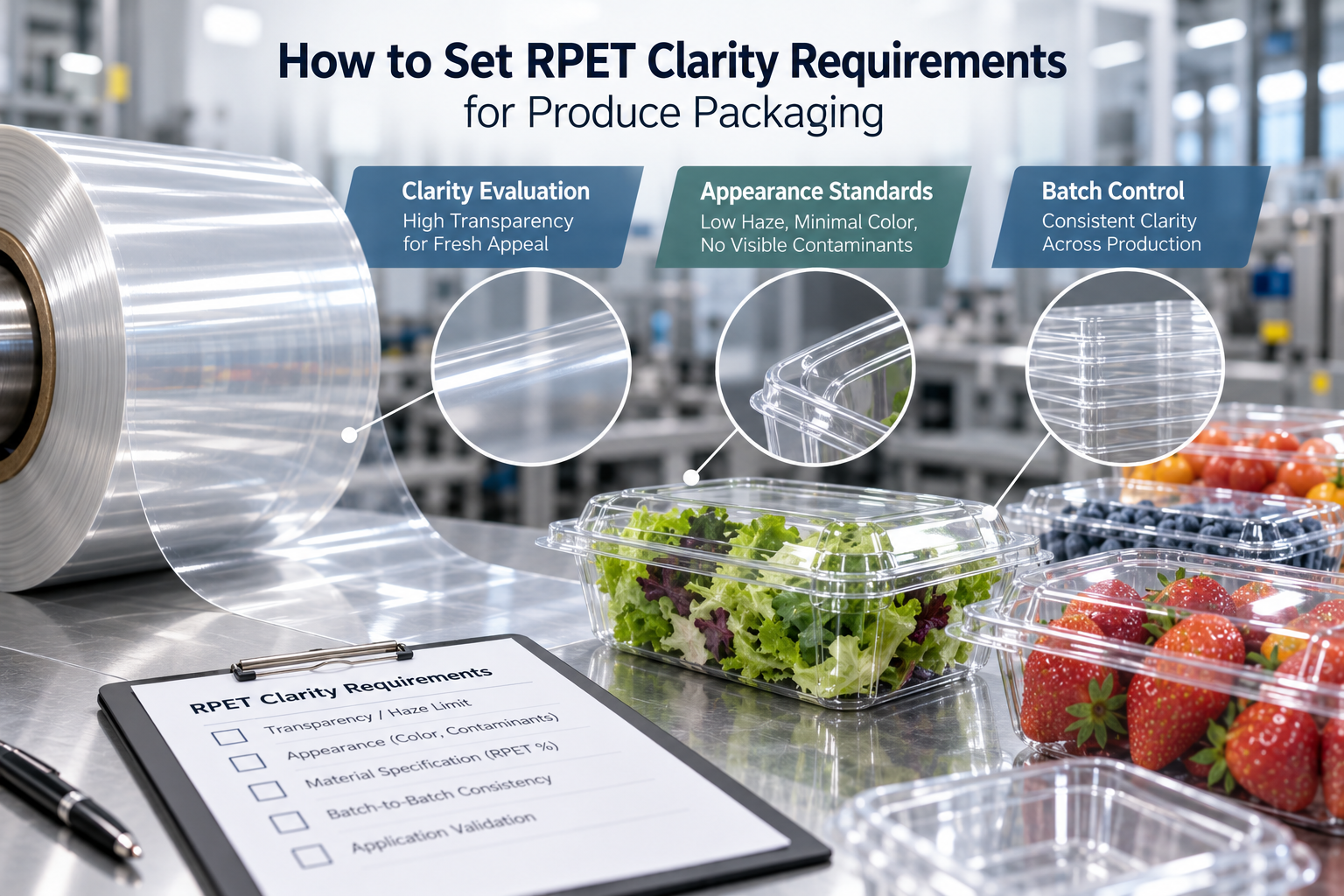
A produce brand asks for more recycled content in its next tray, while the commercial team expects the fruit to look exactly as it does in the current pack. Your quotation request now has two requirements: a PCR percentage and unchanged product visibility. Neither tells the sheet supplier what appearance will actually pass.
Before requesting samples, agree the recycled-content target, the acceptable formed appearance and the method for controlling repeat batches. For PCR RPET produce packaging, these belong in one purchasing specification. Approving the percentage first and negotiating clarity after the forming trial creates avoidable rework.
We would start with the pack drawing and an accepted filled pack. Those establish what the material must deliver before different recycled-content options are compared.
Start with a recycled-content request and a product-visibility requirement
“More recycled content, same clarity” is a useful project objective, but it is not yet an acceptance standard. Does the brand need shoppers to distinguish individual berries through the lid, inspect vegetables through the sidewall, or see the product colour without an objectionable tint? The viewing area matters.
A flat sheet sample cannot settle all of those questions. Review the drawing, draw depth, ribs, corners and the surfaces through which the produce will be viewed. Agree the starting gauge for the trial without treating it as the final production specification.
For produce trays, 0.30–0.70 mm can be a practical starting range for evaluation; geometry and forming results must decide the selected thickness. We would not reduce gauge at the same time as changing recycled content in the first comparison. Keeping the initial comparison focused makes it easier to understand which change affects the result.
The common assumption to challenge is that different PCR levels will look identical. A 30% PCR option and a 100% PCR option should not be approved as visually interchangeable without evidence. Higher recycled content can change clarity and process stability, but the acceptable balance is specific to the pack. The percentage alone does not predict whether the finished tray will pass.
Agree the PCR target and the evidence needed to support it
First establish whether the requested percentage is a mandatory minimum, a preferred target or one option to investigate. That distinction determines what happens if an attractive formed sample falls short of the content requirement.
PCR means post-consumer recycled content. Do not assume that an RPET description or a total recycled-content statement establishes the PCR share. Ask the sheet supplier to distinguish post-consumer material from other recycled inputs in the proposed declaration.
We recommend defining the basis of the percentage before comparing quotations. Is the target expressed by mass across the complete sheet, or does it refer to one layer in a proposed structure? If a declaration concerns only part of the sheet, it cannot automatically be treated as the percentage for the complete sheet or finished package.
A useful request for a PCR PET sheet roll connects the target to evidence that can accompany supply:
| Purchasing concern | What to agree before sampling | What to retain for repeat orders |
|---|---|---|
| PCR target | Minimum or target percentage, calculation basis and treatment of other recycled inputs | Content declaration applicable to the supplied material |
| Sheet construction | Proposed structure and the scope of the content statement | Agreed construction and notification requirements for changes |
| Batch traceability | How sample rolls and delivery lots are identified | Links between delivered rolls, lots and supporting documents |
| Appearance approval | Formed reference pack, inspection conditions and acceptance criteria | Reference samples and inspection results |
| Sampling | Which rolls and formed packs will be checked, and at what stage | The agreed sampling plan and disposition of failures |
A statement about the material is useful only if its scope is clear. Ask what the evidence supports and how it relates to the delivered lot. Do not infer a certification or verified percentage from a product name.
Food-contact suitability also needs its own evidence. A recycled-content declaration does not establish that a selected sheet is suitable for the intended produce contact and use conditions. When requesting food grade RPET sheet, describe the intended use and ask for the applicable supporting documentation alongside the content evidence.
Define acceptable formed appearance using representative produce packs
The most valuable appearance standard is one that purchasing, quality and the brand can apply to the same physical pack and reach the same decision.
Use representative produce, the intended pack geometry and consistent viewing conditions. Inspect empty packs to identify sheet and forming defects, then filled packs to judge visibility. A tint that is unobtrusive when the pack is empty may be unacceptable against the product it contains.
Separate the appearance concerns rather than grouping them under “high clarity”:
- Haze or cloudiness that obscures the produce.
- Colour or tint that changes the perceived product appearance.
- Visible gels, specks or other local defects.
- Scratches and surface marks in critical viewing areas.
- Appearance differences between the lid, walls, corners and other formed features.
These are specification categories, not automatic rejection limits. Decide which matter to the pack and define acceptable boundaries. A mark in a principal viewing window may deserve a different acceptance criterion from a mark in a less visible area.
We would use an approved formed reference together with boundary samples showing the edge of acceptance. One exceptionally clear sample establishes an aspiration; it does not define the variation that routine deliveries may contain. Label the references with their material identification, gauge, forming conditions and approval date so later comparisons remain meaningful.
Where numerical measurements are useful, agree the property, method, specimen location and sample preparation before setting a limit. A flat-sheet result and a measurement taken from a formed wall are not automatically equivalent. Nor should a single haze value replace checks for tint or isolated defects.
Retail appearance needs a second look if the pack will enter chilled display. Evaluate visibility through the actual filling and storage cycle, and distinguish condensation from the material’s underlying appearance. Changing PCR content is a premature response if the visibility problem appears only when the pack fogs.
The professional judgment here is straightforward: approve what the shopper must see through the finished pack. A generic clarity description is too weak for an appearance-sensitive produce project.
Compare samples through forming and repeat-batch checks
Once the content basis and appearance standard are agreed, the trial has a clear purpose: determine whether the proposed recycled content PET sheet meets both requirements under production-like conditions.
Begin with the same drawing, agreed starting gauge and a documented baseline process. Identify every sample roll and record the conditions used to form it. If a candidate needs process adjustments, record those separately. Otherwise, an apparent material improvement may simply reflect a different setup.
Do not inspect only the best tray from the trial. Examine formed packs across the agreed sample positions and operating period. Check product visibility alongside wall distribution, corner definition, trimming, stacking and any closure or sealing operation relevant to the design.
We would judge the candidate on usable formed packs and repeatability, not on the clearest flat swatch. A visually attractive option that requires frequent intervention deserves further evaluation before routine approval. Equally, a candidate should not be rejected solely because it needs a documented adjustment that the line can maintain reliably.
Repeat the comparison with additional production batches where appearance consistency is critical. Request batch-linked samples or inspection results and compare them against the same references. Several unrelated samples without lot identification provide little help when a later delivery differs.
Before routine ordering, settle four release questions:
1. Does the supplied material meet the agreed PCR requirement on the specified basis?
2. Do representative formed packs meet the appearance standard?
3. Can the forming and downstream operations produce acceptable output consistently?
4. Can later deliveries be assessed using the same documents, sampling and acceptance checks?
If a higher-content candidate misses a mandatory appearance requirement, do not quietly relax the standard. Investigate the proposed material and process, then seek another candidate or an explicit project decision. If the content target is optional, a lower-content option may be preferable when it meets the visibility and production requirements more reliably. That trade-off belongs with the brand’s packaging decision, supported by the trial evidence.
Keep recycled content separate from complete-package recyclability
A satisfactory PCR declaration answers a question about material inputs. It does not answer what happens to the complete package after use.
Assess recyclability separately for the actual pack, including its lid, labels, adhesives and other components, and the intended market’s collection and recycling arrangements. Do not use a recycled-content percentage as evidence of complete-package recyclability.
Production-scrap handling is another separate question. Internal trim recovery or scrap collection should not be counted toward the agreed PCR target unless it meets the definition and calculation basis used for that target.
We recommend keeping these three decisions distinct in the specification: recycled content, complete-package recyclability and production-scrap handling. Each needs evidence relevant to its own claim.
FAQ about RPET clarity and PCR requirements
What should we do if an RPET sample passes appearance checks but misses the mandatory PCR target?
Do not approve it against the original specification. Ask for a candidate that meets both requirements, or obtain an explicit revision of the project requirement from the responsible brand or customer. Passing appearance checks does not compensate for failing a mandatory content requirement.
Can photographs serve as the appearance approval standard?
Use photographs to identify inspection areas and illustrate defects, but retain physical formed reference packs for colour, haze and subtle surface comparisons. Lighting, camera settings and screens can change how a pack appears. If remote approval is necessary, agree the imaging conditions and confirm the physical reference before routine supply.
Should one approved RPET sheet specification cover several produce tray designs?
Only after representative trials show that it meets each design’s requirements. Different draw depths, ribs and viewing surfaces can change the formed appearance and processing demands. Group similar designs for evaluation, but do not assume that approval for a shallow tray also approves a deeper pack.
Which changes should trigger a new forming trial?
Agree the triggers with the sheet supplier before routine orders. Changes to PCR target, material structure, formulation, surface treatment, gauge or pack geometry may warrant a new trial or focused checks. Define which changes require notification and what evidence is needed before accepting them.
Share the target content, pack drawing and appearance standard with DESU
Contact DESU with your PCR target and calculation basis, produce-pack drawing, proposed gauge and width, forming requirements and approved appearance references. Include the intended food-contact use and batch-documentation requirements so the discussion can focus on a meaningful sample and forming-trial plan.
Related Articles
CONTACT PET-SHEET.COM
Our professional sales staff and technicians will determine the final characteristics of the product and material solution for the customer specific application and will provide the customer with a quote and a detailed time schedule, Please fill the form to contact our professional sales team.- Main Category
- APET Sheet Roll
- ESD Antistatic PET Sheet Roll
- GAG Sheet Roll
- PETG Sheet Roll
- RPET Sheet Roll
- Thermoforming PET Sheet Roll
- Latest Products