 PET-SHEET.COM


What Are the Key Advantages of Using PET Antistatic Sheets in Electronic Blister Packaging?
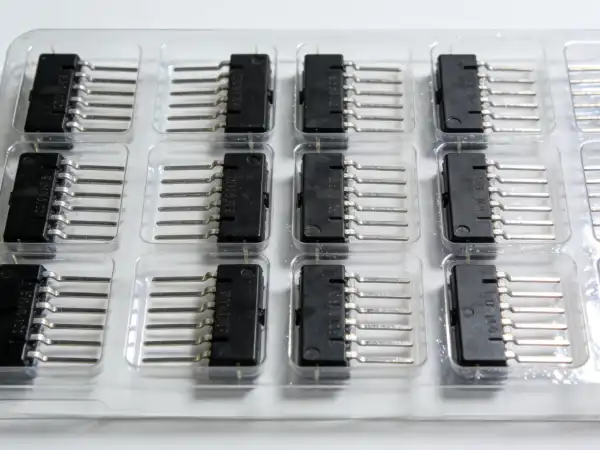
Introduction: Why Antistatic Packaging Is No Longer Optional
In the past decade, I have worked closely with customers across consumer electronics, automotive electronics, industrial control systems, and semiconductor supply chains. One trend is unmistakable: electrostatic discharge (ESD) risks are increasing, not decreasing.
Components are becoming:
- Smaller
- More sensitive
- Higher in unit value
At the same time, global logistics chains are longer, faster, and more complex. Under these conditions, traditional packaging materials are no longer sufficient.
This is why PET antistatic sheets have become a preferred material for electronic blister packaging—not just as a technical upgrade, but as a risk-management decision.
In this article, I will explain—based on real production and customer experience—the key advantages of using PET antistatic sheets, structured from three critical perspectives:
- Core material and performance advantages
- Supply chain and operational advantages
- End-user experience, compliance, and procurement value
This is not a generic material overview. It is written to help buyers make better decisions.
1. Core Advantages: Material Performance That Protects Electronics
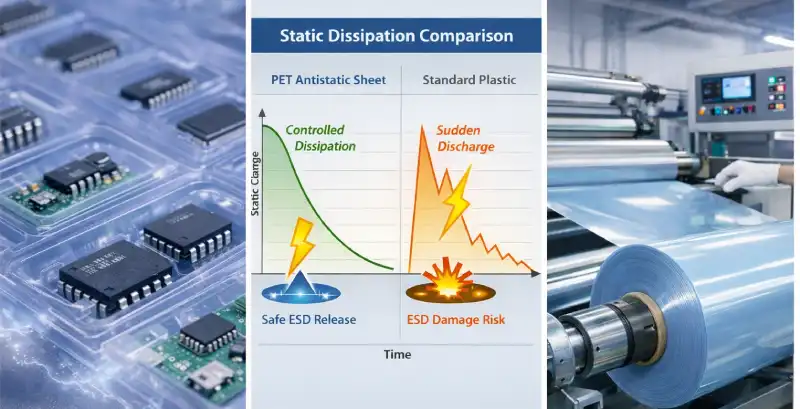
1.1 Controlled Static Dissipation, Not Just “Antistatic Claims”
One common misconception is that all “antistatic plastics” perform the same. In reality, how static is controlled matters more than the label.
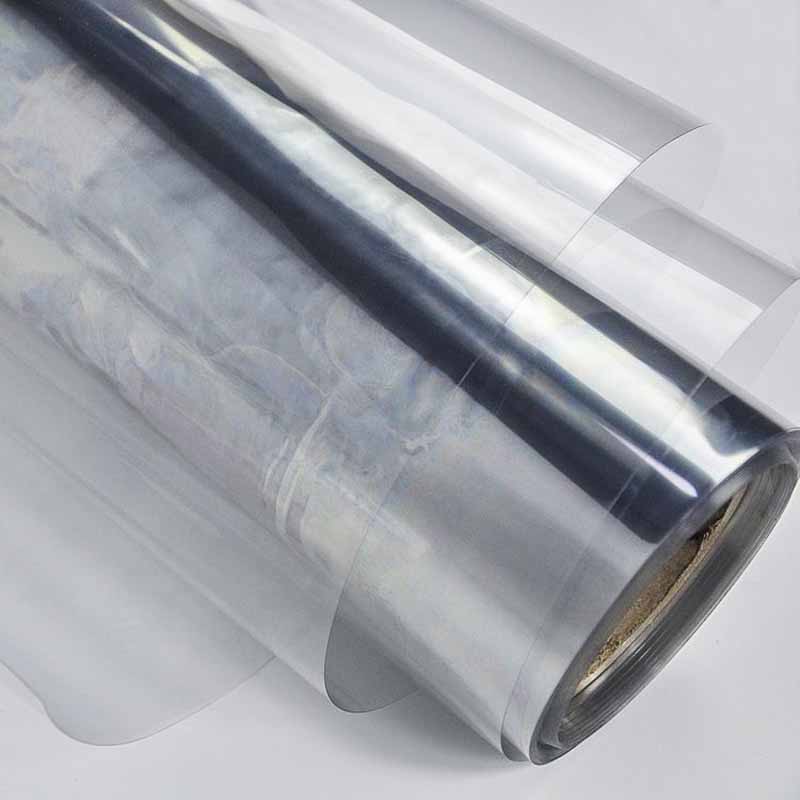
High-quality PET antistatic sheets provide:
- Surface resistivity typically in the range of 10⁶–10⁹ Ω/sq
- Controlled, gradual static dissipation
- No sudden discharge that could damage sensitive components
From a production standpoint, this stability is achieved through:
- Permanent antistatic additives (not topical coatings)
- Uniform dispersion during extrusion
- Consistent resistivity across the full sheet width and length
Procurement insight:
Ask your supplier whether the antistatic effect is permanent or migratory. Migratory additives can lose effectiveness during storage or transport.
1.2 PET’s Natural Mechanical Stability Enhances Blister Protection
Compared to PS or PVC, PET offers:
- Higher impact resistance
- Better dimensional stability
- Lower brittleness under thin-gauge forming
For electronic blister packaging, this translates to:
- Better cavity definition
- Less cracking during trimming
- Reduced breakage during handling and shipping
In my experience, mechanical failure causes more product damage than static alone. PET antistatic sheets address both risks simultaneously.
1.3 Excellent Thermoforming Window for Complex Electronic Cavities
Electronic components often require:
- Deep draws
- Tight tolerances
- Complex multi-cavity layouts
PET antistatic sheets offer:
- Uniform heating behavior
- Stable forming temperature range
- Reduced thinning at corners and edges
This consistency is critical for:
- Automated high-speed thermoforming lines
- Maintaining cavity fit across large production runs
1.4 Optical Clarity Without Compromising Protection
Many electronic blisters must allow:
- Visual inspection
- Barcode scanning
- Product identification without opening
PET antistatic sheets can achieve:
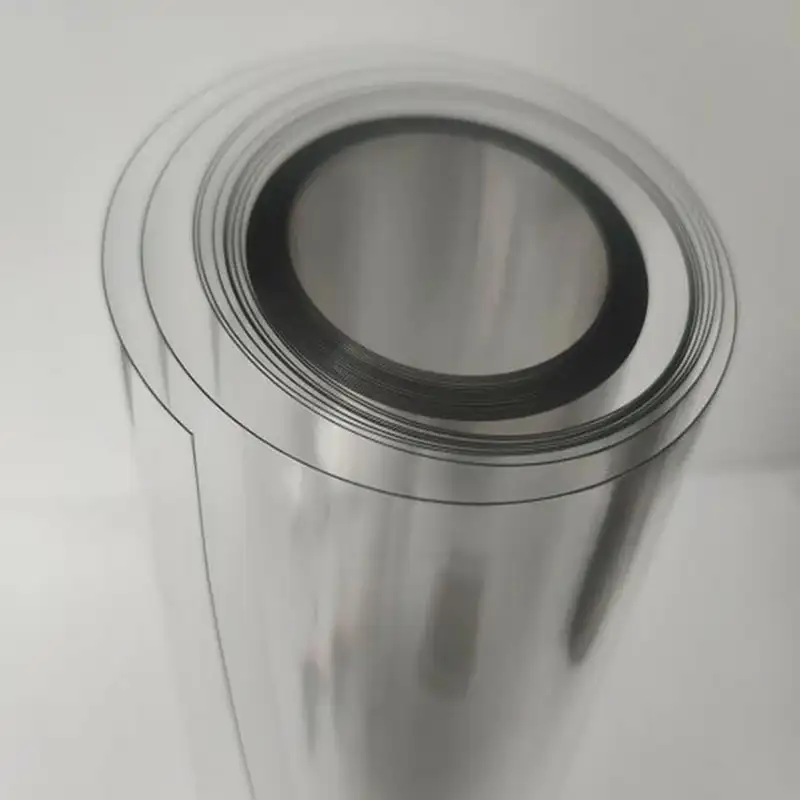
- High transparency
- Low haze
- Clean surface appearance
Unlike some conductive plastics, PET antistatic materials do not sacrifice aesthetics for performance.
2. Supply Chain & Operational Advantages: Why Buyers Prefer PET Antistatic Sheets
2.1 Process Stability Reduces Hidden Production Costs
From a factory perspective, material instability creates:
- Line stoppages
- High scrap rates
- Inconsistent forming results
PET antistatic sheets offer:
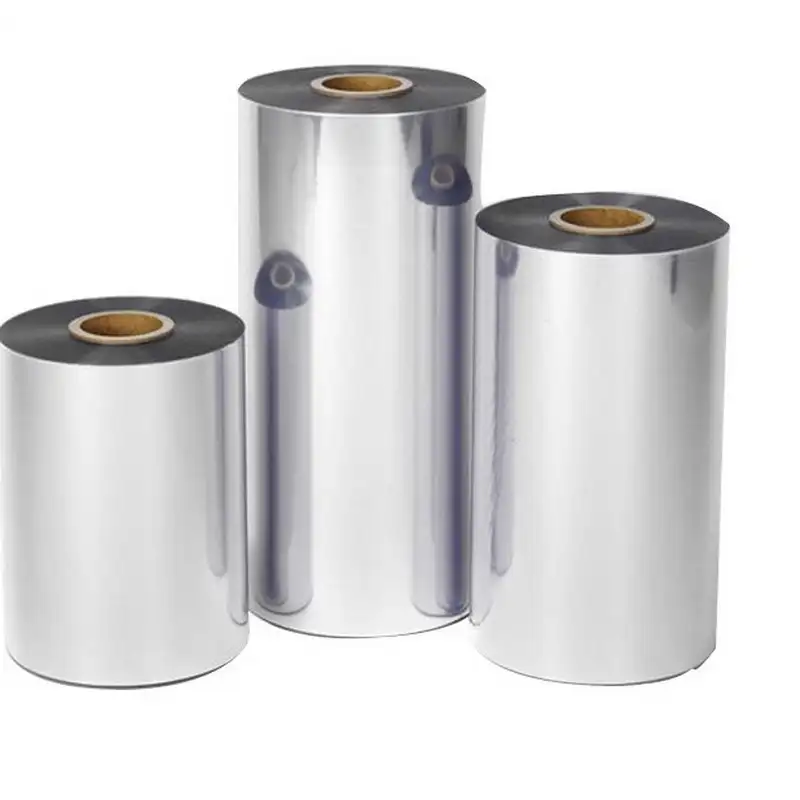
- Stable roll-to-roll thickness
- Consistent resistivity across batches
- Predictable forming behavior
Procurement value:
Lower scrap rates and fewer line adjustments often outweigh small differences in material price.
2.2 Compatibility with Existing Thermoforming Equipment
One reason PET antistatic sheets are widely adopted is their drop-in compatibility:
- No special tooling required
- No conductive grounding modifications
- Compatible with standard PET forming setups
For operations managers, this means:
- No capital investment
- Minimal retraining
- Faster material qualification
2.3 Reliable Global Supply and Specification Repeatability
In electronics packaging, spec consistency is critical. PET antistatic sheets are:
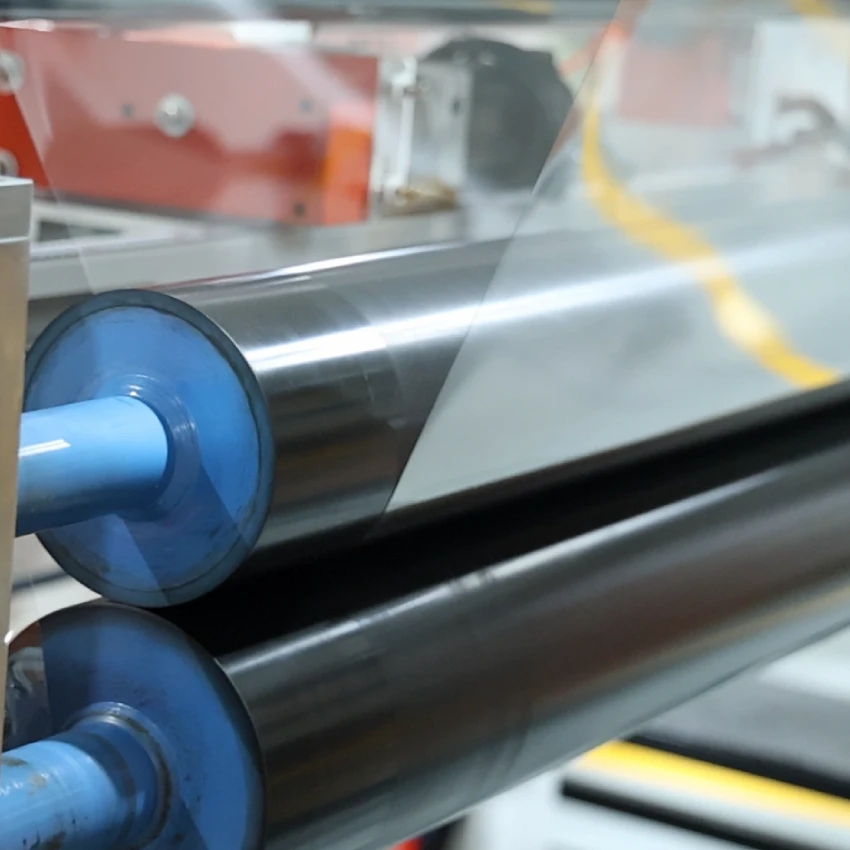
- Produced on dedicated PET extrusion lines
- Less sensitive to formulation variation than conductive fillers
- Easier to standardize across suppliers and regions
At DESU Plastic, we often see customers qualify PET antistatic sheets specifically to:
- Reduce supplier risk
- Enable dual-source strategies
- Maintain global packaging consistency
2.4 Better Shelf Life and Storage Stability
Unlike coated or surface-treated materials, high-quality PET antistatic sheets maintain performance over time:
- No rapid decay of antistatic effect
- Minimal sensitivity to humidity changes
- Stable properties during long-distance transport
This is especially important for:
- Export-oriented electronics
- Long inventory cycles
- Contract manufacturing models
3. End-User Experience & Compliance: Where Procurement Decisions Are Won
3.1 Protection Throughout the Entire Product Lifecycle
Electronic blister packaging must protect products across:
- Manufacturing
- Warehousing
- Transportation
- Retail handling
- End-user opening
PET antistatic sheets provide:
- Continuous ESD protection
- Mechanical integrity until final use
- Clean, professional appearance
From customer feedback, end users associate:
- Clear, rigid PET blisters with higher product value
- Poor packaging with quality risk—even if the product itself is fine
3.2 Compliance with Electronics Industry Requirements
PET antistatic sheets can be engineered to meet:
- ESD handling standards (IEC / ANSI guidelines)
- RoHS compliance
- REACH requirements
- Food-contact compliance (when required for crossover applications)
Procurement insight:
Using PET simplifies compliance documentation compared to multi-material or coated solutions.
3.3 Sustainability and Recycling Considerations
Sustainability is no longer optional in electronics packaging procurement.
PET antistatic sheets offer:
- Compatibility with PET recycling streams (depending on formulation)
- Potential use of recycled PET (rPET) in non-critical layers
- Lower environmental impact compared to PVC
For global brands, this supports:
- ESG reporting
- Packaging reduction initiatives
- Regulatory alignment in EU and North America
3.4 Lower Total Cost of Ownership (TCO)
While PET antistatic sheets may not always be the cheapest per kilogram, they often deliver:
- Lower scrap rates
- Fewer product failures
- Reduced warranty and return risks
- Higher customer satisfaction
From a 10-year production manager’s perspective:
The most expensive packaging material is the one that causes product loss.
4. Why Procurement Teams Choose PET Antistatic Sheets Over Alternatives
| Decision Factor | PET Antistatic Sheet Advantage |
|---|---|
| ESD Protection | Controlled, stable dissipation |
| Mechanical Strength | High impact resistance |
| Forming Consistency | Wide thermoforming window |
| Visual Quality | High clarity and aesthetics |
| Supply Stability | Mature global PET supply |
| Compliance | Easier certification |
| Long-Term Cost | Lower TCO |
5. Common Buyer Mistakes (and How to Avoid Them)
From real customer cases, I see these recurring issues:
- Choosing antistatic materials based only on lab data, not forming performance
- Ignoring batch-to-batch resistivity variation
- Underestimating storage and logistics effects
- Selecting the lowest-price supplier without long-term consistency guarantees
Key advice:
Always evaluate material + process + supply reliability together.
Conclusion: A Production Manager’s Final Perspective
From over a decade in PET sheet manufacturing and electronic packaging projects, my conclusion is clear:
PET antistatic sheets are not just a packaging material—they are a risk-reduction tool.
They protect:
- Your product
- Your production efficiency
- Your brand reputation
- Your customer experience
For electronic blister packaging, especially in high-value or sensitive components, PET antistatic sheets represent a balanced, proven, and procurement-friendly solution.
CONTACT PET-SHEET.COM
Our professional sales staff and technicians will determine the final characteristics of the product and material solution for the customer specific application and will provide the customer with a quote and a detailed time schedule, Please fill the form to contact our professional sales team.- Main Category
- APET Sheet Roll
- ESD Antistatic PET Sheet Roll
- GAG Sheet Roll
- PETG Sheet Roll
- RPET Sheet Roll
- Thermoforming PET Sheet Roll
- Latest Products