 PET-SHEET.COM


Why Clear APET Sheet Can Turn White in Deep Packaging Shapes
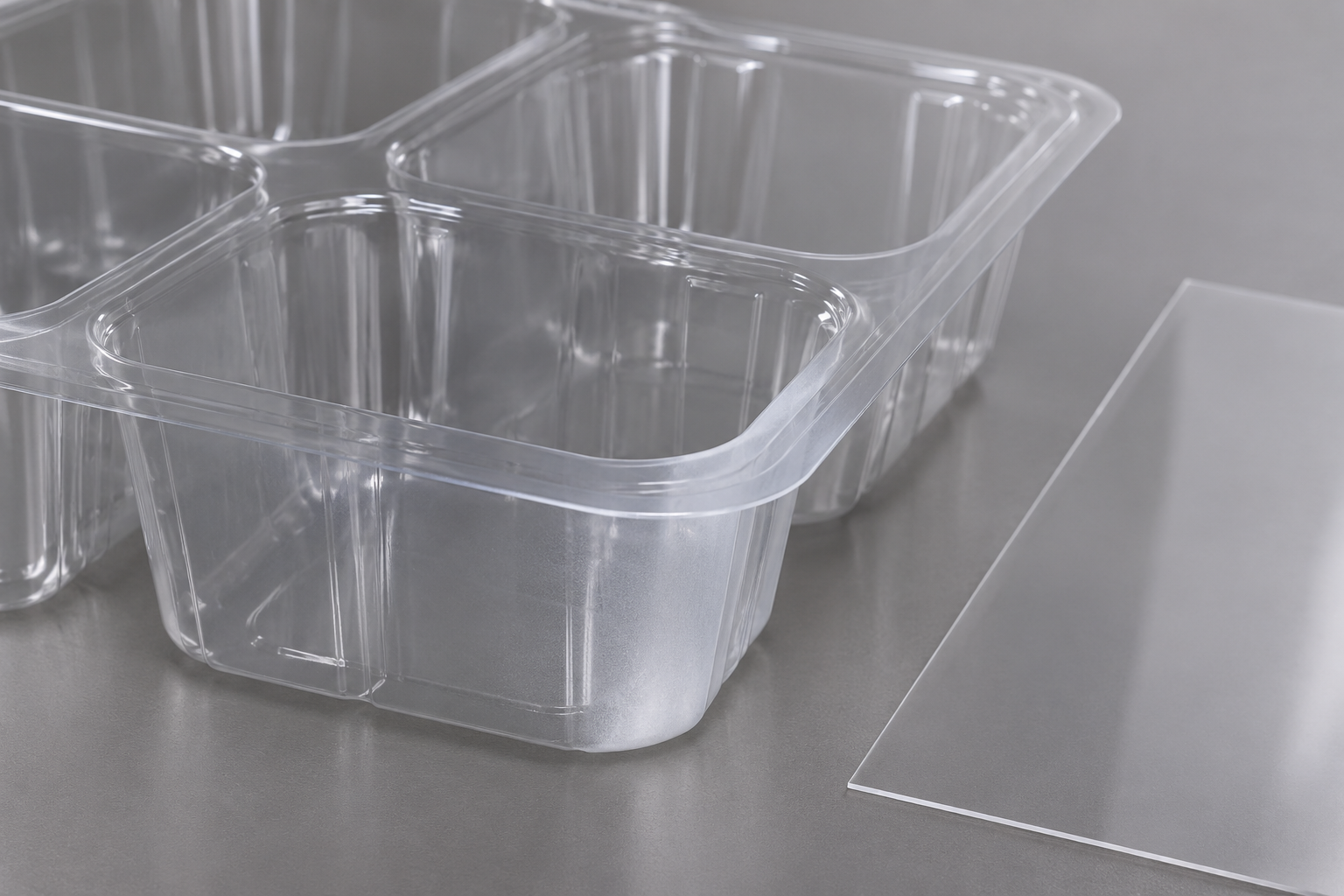
The APET sheet looks clear on the roll, but a deeper packaging shape comes out with white patches around its corners or lower walls. A replacement sheet is an obvious option to consider. The purchasing question is whether to change the material specification—and what evidence would make that change worthwhile.
Clear APET sheet can develop whitening in highly stretched areas because formed appearance depends on the interaction between the material, local stretching and heating conditions. Flat-sheet clarity cannot establish how the same sheet will look throughout a deep package. The location of the whitening helps direct the investigation, but it does not identify the cause by itself.
We would start by comparing the incoming sheet with the affected formed areas before requesting a different formulation or a heavier gauge.
Locate the whitening and distinguish it from flat-sheet haze
Keep an unformed sample from the same roll alongside the formed package. Examine both under consistent lighting and against the same background. Identify whether the loss of clarity was present before forming or appears only after the sheet takes its final shape.
A broadly hazy flat sample raises a different material-quality question from a clear sample that whitens only at a tight corner. Likewise, a surface scuff and a white area through the formed wall may look similar in a photograph but require different investigation. Retain physical samples when possible.
Mark the affected locations on the package drawing: corners, wall transitions, ribs or other deeply drawn features. Also note whether the appearance is consistent across cavities and repeated parts. These observations help distinguish a recurring material question from a localized interaction with the package geometry or forming conditions.
For a large cake dome, for example, a clear flange does not settle the appearance question if the deeper display area becomes white. The purchasing requirement must describe clarity where the customer actually views the product.
Assess sheet formulation, gauge and local stretching together before requesting a material change
Our recommendation is to investigate these three factors together. Changing one without understanding the others can add material cost while leaving the appearance problem unresolved.
Formulation matters, but the APET name is only a starting point
Two APET sheets with the same nominal thickness need not behave identically during forming. Formulation, sheet construction, surface condition and consistency can influence suitability for a demanding shape.
Ask the APET sheet manufacturer to compare the supplied specification with the intended draw and appearance requirement. Useful questions concern the material composition, any declared recycled content, additive or surface-treatment differences, and changes between the approved sample and the supplied lot. A difference is a reason to investigate; it is not proof that a particular ingredient caused the whitening.
An alternative formulation intended to improve appearance under stretching may be worth discussing. However, an “anti-whitening” description is not sufficient evidence of suitability. Establish what the proposed option changes, which application it is intended for and how its formed appearance will be assessed. Do not assume that a formulation change will compensate for every geometry or processing limitation.
Starting gauge does not describe the deepest formed wall
A nominal sheet gauge tells you the incoming thickness. It does not show how material will be distributed around the package after stretching.
Deep features and tight transitions can concentrate stretching locally. Measure the affected area and compare it with clearer areas rather than judging the part by overall depth alone. The useful question is whether the proposed sheet specification supports the required appearance and remaining wall thickness in those locations.
A heavier sheet may be a reasonable comparison option where local thinning is a concern, but it also increases material consumption and can change forming behavior. We would not recommend increasing gauge solely because the package is deep. First establish whether the white area corresponds to an especially demanding stretch and whether a gauge change addresses that requirement.
Heating and geometry remain part of the material assessment
The same sheet can encounter different stretching conditions depending on its heating history and the shape being formed. A tight corner and a broad wall do not impose the same local demand.
Record the heating profile and relevant forming conditions during comparisons so that the material results remain interpretable. This is evidence for evaluating sheet suitability, rather than a reason to prescribe a universal machine setting.
If whitening changes substantially while the sheet remains unchanged, investigate the processing contribution before concluding that the lot is defective. If a specification difference repeatedly corresponds with poorer appearance under comparable conditions, a material discussion becomes better grounded. Neither observation alone establishes a complete diagnosis.
The most useful replacement proposal therefore explains the specification difference and the appearance requirement it is intended to address. A different material name without that connection offers little purchasing value.
What flat-sheet clarity can and cannot establish
Flat-sheet inspection remains valuable. It provides an incoming appearance baseline and can reveal haze, tint, visible contamination or surface marks before conversion. Keep that baseline when comparing lots or discussing a complaint.
It cannot establish clarity after substantial stretching. Nor can an attractive flat sample demonstrate acceptable corner appearance, wall distribution or repeatability in the intended package.
For appearance-sensitive APET packaging, we would define acceptance in two parts: incoming-sheet appearance and formed-package appearance. Specify the viewing areas, lighting, background and agreed comparison sample. If optical measurements are used, agree on the method and sample location so that flat-sheet and formed-part results are not treated as interchangeable.
Avoid an acceptance requirement such as “high clarity” on its own. A more useful requirement identifies where visible whitening is unacceptable and how the finished sample will be judged. Set the actual limits jointly rather than borrowing an unrelated numerical target.
Appearance evidence and supplier questions for discussing specification options
A concise evidence package makes the discussion with an APET sheet roll supplier more productive than a request for “better clear material.” Include the following:
| Evidence or project input | What it helps establish |
|---|---|
| Package drawing with depth, transitions and affected areas marked | Where the sheet faces the greatest appearance demand |
| Current sheet specification, nominal gauge and measured thickness | The material baseline being evaluated |
| Lot identification and retained unformed samples | Whether the appearance concern can be traced to particular supply |
| Formed samples and photographs under consistent lighting | The location and nature of the visible whitening |
| Local wall-thickness measurements | Whether whitening coincides with concentrated thinning |
| Recorded heating profile and comparison conditions | Whether material comparisons were made on a meaningful basis |
| Agreed appearance sample and viewing requirements | What a suitable alternative must achieve |
Ask which specification options are technically relevant to that evidence. These might include a formulation comparison, tighter incoming thickness control or a different starting gauge. Treat them as proposals to evaluate, with their cost and processing implications stated clearly.
Compare acceptable formed output as well as sheet price per kilogram. A higher-priced option needs a demonstrated application benefit; a lower-priced option needs to meet the same appearance requirement. One attractive sample is also a weak basis for repeat purchasing, so agree how subsequent lots will be compared with the approved baseline.
For food-contact applications, assess documentation for the selected sheet and intended use separately. Clear appearance does not establish food-contact suitability.
FAQ About APET Whitening
Can photographs alone show whether the APET sheet is defective?
No. Photographs help locate whitening, but lighting, reflections and surface marks can obscure its nature. Retain unformed and formed samples from the same lot, identify the affected areas and provide the sheet specification and comparison conditions before assigning a cause.
Should every white corner be rejected?
Rejection should follow the agreed package requirements. A white area in a critical display zone may be unacceptable even when the shape is complete. Appearance alone also cannot establish mechanical suitability, so assess any relevant wall-thickness or functional requirements separately.
Does an anti-whitening formulation remove the need to assess package geometry?
No. A formulation proposed for improved formed appearance still needs evaluation against the actual geometry, local stretching and intended conditions. Ask what specification difference is being offered and agree on the formed-part acceptance criteria before approving it.
What if the original sheet specification is unavailable?
Provide the supplier with retained material, measured gauge, roll identification where available, the package drawing and representative formed samples. Ask for a proposed specification based on those requirements, and document the selected material before repeat purchasing rather than assuming it matches the original sheet.
Share the package drawing, sheet specification and appearance requirements to discuss suitable samples
Share your package drawing, current APET sheet specification, photographs of the affected areas and purchasing requirements with DESU. Include the appearance standard you need to meet so we can discuss suitable samples or a quotation around the actual package requirement.
CONTACT PET-SHEET.COM
Our professional sales staff and technicians will determine the final characteristics of the product and material solution for the customer specific application and will provide the customer with a quote and a detailed time schedule, Please fill the form to contact our professional sales team.- Main Category
- APET Sheet Roll
- ESD Antistatic PET Sheet Roll
- GAG Sheet Roll
- PETG Sheet Roll
- RPET Sheet Roll
- Thermoforming PET Sheet Roll
- Latest Products