 PET-SHEET.COM


Why Does Clear APET Sheet Turn White When Forming a Cake Dome?
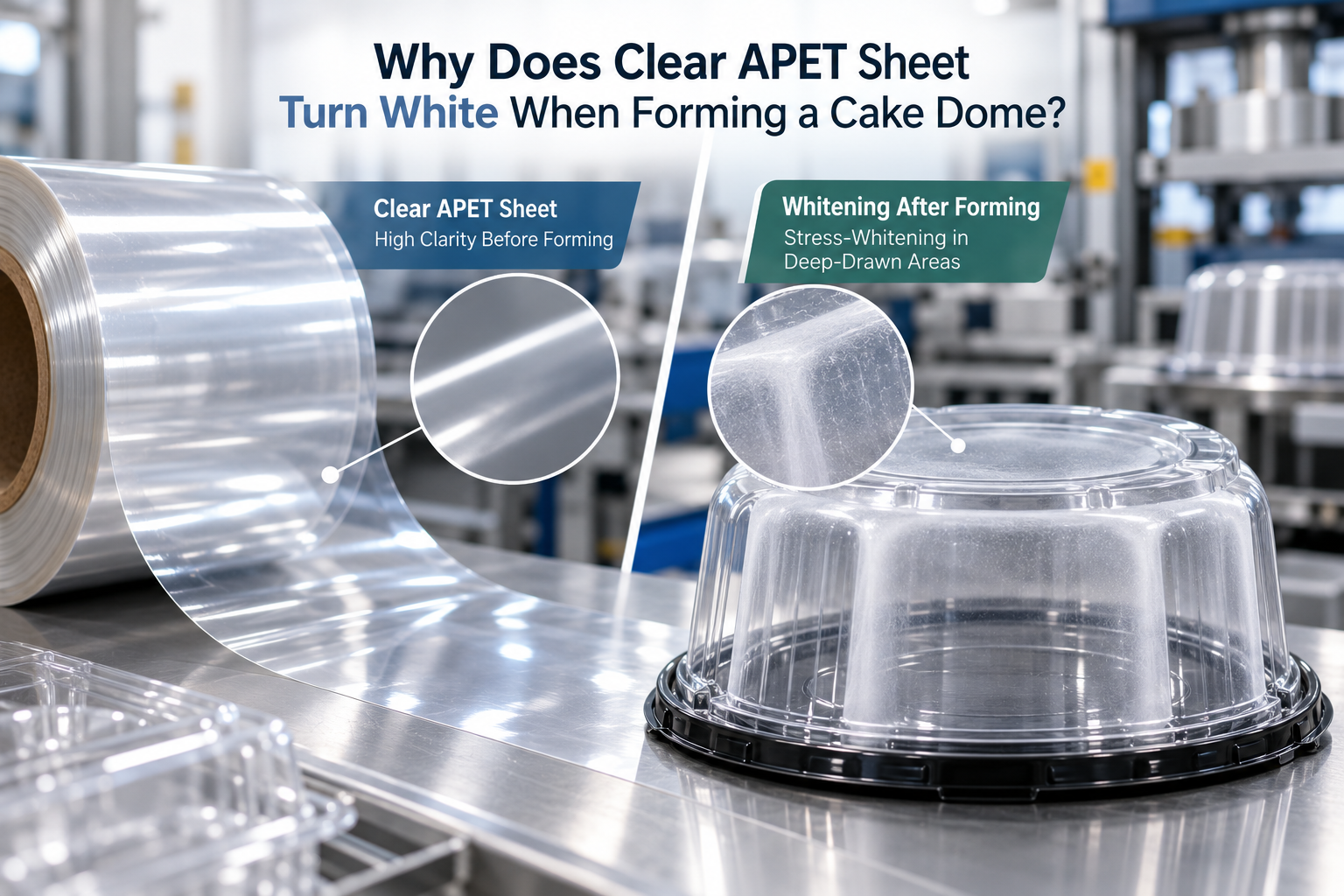
The flat APET sample looks clear, so you approve a forming trial. Then the cake dome comes off the tool with a white band around the shoulder or a cloudy patch in the deepest drawn area. Through that part of the cover, the cake no longer looks as it should.
Is the sheet unsuitable, or does the forming setup need adjustment?
Clear APET sheet can lose its clear appearance during deep drawing because the material, heating conditions and draw distribution must work together. Flat-sheet clarity alone cannot establish whether a sheet is suitable for a cake dome. The location of the whitening and its response to controlled trials are more useful than the appearance of another flat sample.
We would start by comparing the affected dome with its drawing and trial settings before recommending a different gauge or formulation. Changing the specification immediately can hide the original problem and leave you paying for a change that has not been properly evaluated.
Locate the whitening against the dome geometry and wall distribution
Keep an unformed sample from the same trial roll beside the affected dome. Mark exactly where the appearance changes: the crown, shoulder, sidewall, a tight transition or the area near the rim. Photograph the complete dome and the marked areas under consistent lighting.
The deepest area deserves close inspection, but do not assume it is automatically the thinnest. Measure the formed wall at selected locations and relate those measurements to the drawing. A dome’s overall height does not tell you how evenly the sheet has stretched through its shoulders and transitions.
A narrow white band and a broadly cloudy dome call for different investigations. The following observations help organize the next trial; they do not establish a cause by themselves.
| Trial observation | What to compare next | Decision value |
|---|---|---|
| Whitening repeatedly follows the same shoulder or transition | Local wall thickness, geometry and heating distribution | Identifies a feature that needs closer forming evaluation |
| Whitening appears mainly on one side | Heating observations and wall measurements on opposite sides | Helps assess whether the forming conditions are uneven |
| Several areas lose clarity as heating settings change | The recorded heating profile and formed appearance at each setting | Shows how sensitive the result is to the heating conditions |
| Different trial rolls behave differently | Actual incoming gauge, material details and repeat trials under the same baseline conditions | Helps separate a material difference from a setup difference |
One thing we check first is whether the whitening repeats in the same location across several parts. A single dome is useful for locating a defect, but it is a weak basis for approving a material change.
Also record when the mark first becomes visible. Inspect the dome after forming and again after trimming and handling. If the appearance changes later, keep those stages separate in the investigation rather than assigning every white mark to the forming operation.
Once the defect has a location and a repeatable pattern, the next question becomes more precise: can the current sheet meet the appearance requirement under suitable forming conditions?
Compare material and heating observations through controlled forming trials
Start with a documented baseline using the current APET sheet. Record the roll or lot identification, actual incoming thickness, tool, heating settings, heating time, forming sequence and production speed. Where sheet-temperature measurements are available, record the measurement method and locations as well. Heater settings and measured sheet temperature are different observations and should be identified separately.
Retain both acceptable and unacceptable domes from that baseline. Label each with its trial conditions so a clearer sample can be traced to the adjustment that produced it.
Evaluate heating without losing the comparison
Increasing heat across the machine is an uncontrolled first response to a localized appearance complaint. It may change several parts of the dome at once, making the result harder to interpret.
Instead, make a defined adjustment to the relevant heating condition while holding the material, tool and other settings steady as far as practical. Compare the same marked areas after each run. Look at clarity alongside wall distribution, shape and forming stability.
We would not approve an adjustment simply because one dome looks clearer. It must also produce an acceptable part repeatedly under conditions the line can maintain. A visually good sample achieved through an unstable setup is a poor purchasing baseline.
If the affected area improves, repeat the trial to establish whether the improvement is dependable. If it remains white, use the wall measurements and geometry to decide whether further work on draw distribution is justified. Heating and stretching interact, so retain the full trial observations rather than recording only “better” or “worse.”
Compare another sheet only after establishing the baseline
When the current material cannot meet the agreed appearance requirement under workable forming conditions, a material comparison becomes meaningful. Ask the APET sheet manufacturer to identify the proposed material or formulation change and explain what the trial is intended to evaluate.
An APET formulation intended to reduce whitening may be a candidate for testing. The description alone does not establish that it will solve the complaint on your dome.
Two sheets with the same APET name and nominal gauge can run differently because their formulation, surface condition and roll consistency may differ. Compare the replacement with the current material at the documented baseline first. Then, if necessary, evaluate suitable settings for each material separately. This distinguishes a direct substitution from a change that requires a different forming setup.
For a new cake-dome project, 0.40–0.90 mm can be a practical trial starting range, with final gauge determined by the drawing, draw depth, wall distribution and finished-package requirements. It is neither a prescribed cake-dome specification nor evidence that a thicker sheet will eliminate whitening.
Our recommendation is to establish acceptable formed clarity and production stability before pursuing the lowest gauge. A thickness change deserves its own trial, including checks on the rim, thin areas, stacking and handling performance.
When requesting a PET sheet sample for a thermoforming trial, provide enough material for setup and repeat observations. A small clear swatch can help assess incoming appearance; it cannot qualify the sheet for the complete dome.
Define formed-appearance acceptance before approving a sheet change
“Clear enough” is difficult to purchase against. The sheet supplier, forming operator and packaging customer need a shared way to judge the finished dome.
Agree on an acceptable physical sample or visual standard before comparing candidates. Specify the viewing conditions, the areas to inspect and how borderline samples will be handled. Look through the dome toward the cake or a representative display background, as well as inspecting the empty part. The appearance requirement exists because the cover must present the product.
Use a short approval checklist:
- Identify the crown, shoulder, deepest drawn areas and rim to be inspected.
- Define acceptable whitening or haze against the agreed visual standard.
- Select wall-thickness measurement locations and agree on the method and project limits.
- Check shape, base fit, trimming and the required stacking and handling performance.
- Agree on sampling across the trial run and any repeat lots needed for qualification.
- Retain labeled samples and the settings associated with the accepted result.
We would give repeatable formed appearance more weight than one exceptional sample. An attractive dome from a carefully adjusted short run does not yet demonstrate consistency for repeat orders.
The approval decision should follow the evidence. If a controlled process adjustment gives the existing sheet acceptable clarity and stable forming, a sheet change may be unnecessary. If a candidate material meets the same criteria more consistently under workable conditions, the change has a defensible basis. If neither does, revisit geometry and draw distribution before requesting another material name.
Keep cost in that comparison, but use the cost of acceptable output. PET sheet roll price per kilogram leaves out differences in formed-part weight, rejection rate and line interruptions. Paying more for a sheet is justified only when the trial supports a useful production or package-quality benefit.
FAQ About APET Cake-Dome Whitening
Can I approve a replacement APET sheet using domes formed on the supplier’s machine?
Supplier-formed domes can support preliminary evaluation, but final approval should include a trial on your production equipment with the intended tool. Differences in heating, forming sequence and operating conditions can change the result. Ask for the supplier’s trial conditions so the samples provide a useful comparison.
What samples should I keep when reporting a whitening complaint?
Keep unformed sheet from the affected roll, several whitened domes and any acceptable domes produced during the trial. Label them with the roll or lot identification and forming conditions. Include photographs showing the defect location and when it first appears, especially if the appearance changes after trimming or handling.
Should I reduce gauge while testing a different APET formulation?
Evaluate the formulation at the current gauge first. Changing formulation and thickness together makes it difficult to identify why the result changed. Once the candidate meets the appearance and forming requirements, assess a gauge reduction separately, including wall distribution, rim performance, stacking and handling.
Does acceptable clarity mean the cake dome is fully approved for food packaging?
No. Appearance approval addresses only one part of the specification. Confirm the food-contact documentation applicable to the selected sheet and intended market, along with the package’s fit, handling and end-use requirements. A clear formed sample does not establish those requirements by itself.
Send DESU the dome drawing, affected samples and trial observations
Send DESU the dome drawing, diameter and draw depth, current sheet specification, affected and acceptable samples, and your recorded heating and forming observations. Include the formed-appearance standard you need to meet. These details provide a practical basis for discussing a controlled trial and whether a sheet change is warranted.
Related Articles
CONTACT PET-SHEET.COM
Our professional sales staff and technicians will determine the final characteristics of the product and material solution for the customer specific application and will provide the customer with a quote and a detailed time schedule, Please fill the form to contact our professional sales team.- Main Category
- APET Sheet Roll
- ESD Antistatic PET Sheet Roll
- GAG Sheet Roll
- PETG Sheet Roll
- RPET Sheet Roll
- Thermoforming PET Sheet Roll
- Latest Products